
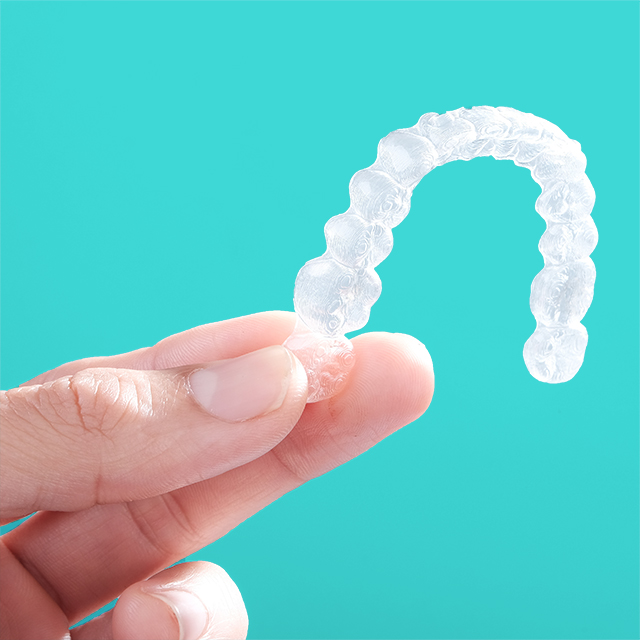
If you are weighing clear aligners against braces, you have probably noticed that most of what turns up online reads like an advertisement for one or the other. The honest version is less exciting. Both straighten teeth and both work well. The real question is which one suits your case and your habits, and that is a smaller, more personal question than the internet makes it out to be.
Here is how each one works, where they actually differ, and how the decision gets made.
Clear Aligners and Clear Braces Are Not the Same Thing
This trips up almost everyone, so it is worth sorting out first. There are three options on the table, not two.
- Metal braces. Small brackets bonded to each tooth and connected by a wire. The most familiar option and the most versatile.
- Clear braces. The same system, but with ceramic brackets that blend into the color of the tooth. Still fixed, still handles the same range of movement.
- Clear aligners. Removable trays that fit over the teeth. A completely different approach rather than a variation on braces.
So when someone says they want “the clear ones,” they might mean either of two very different treatments. Clear braces are still braces. Aligners are something else.
How Clear Aligners Work
Aligners are custom trays made to fit your teeth exactly. You wear them 20 to 22 hours a day and take them out to eat, to drink anything other than water, and to brush. Every week or two you move to the next tray in the series, and each one shifts your teeth slightly closer to where they need to end up.
The whole sequence gets planned before you wear a single tray. A digital scan of your teeth becomes a movement plan, and the trays are manufactured from it. We use Invisalign and Invisalign Teen here.
The appeal is straightforward. The trays are difficult to notice, they come out for meals so nothing is off limits, and brushing and flossing stay exactly as they were.
How Braces Work
Braces use brackets bonded to each tooth with a thin archwire threaded through them. The wire applies steady pressure, and adjustments every few weeks guide the teeth where they need to go.
The important difference is that braces are working every hour of every day whether you think about them or not. Nothing gets forgotten on a nightstand. That single fact drives most of what follows.
How They Compare Day to Day
- Appearance. Aligners are the least visible option. Clear braces are subtle but still visible up close. Metal braces are obvious, which some kids genuinely enjoy given the color choices.
- Eating. Aligners come out, so nothing is restricted. With braces there is a real list of foods to avoid, mostly hard and sticky things that break brackets.
- Cleaning. Aligners come out and you brush normally. Braces need a floss threader or a water flosser and a few extra minutes.
- Comfort. Aligners feel tight for a day or two with each new tray. Braces are sore for the first week and after adjustments, and the brackets can rub until your cheeks adapt.
- Visits. Both need regular check-ins, usually every several weeks, though aligner appointments tend to be shorter.
- Complexity handled. Braces cover more ground, particularly on difficult movements. Aligners handle a wide range but not everything.
- Discipline required. This is the biggest gap. Aligners only work while they are in your mouth. Braces do not care what you remember.
What Each One Can and Cannot Correct
Aligners generally do well with mild to moderate crowding, gaps and spacing, minor bite corrections, and cases where teeth have drifted after previous treatment.
Braces tend to be the better tool for severe crowding, significant rotations, teeth that need to move vertically, and bite corrections that need precise mechanics.
Bite problems sit on a spectrum rather than in a category. An overbite, underbite or crossbite that is mild may respond well to aligners, while the same problem in a more pronounced form usually calls for braces. Where the lower jaw itself sits too far back, correction often involves an appliance that works alongside braces rather than either treatment on its own.
Some cases use both. Braces do the heavy work first, then aligners handle the refinement at the end. That is a normal plan, not a compromise.
The Thing That Decides It More Than Anything Else
Aligners ask something of you that braces do not. Twenty hours a day, every day, for months. Not most days. Every day.
When trays are worn as planned, aligners are excellent. When they are not, the teeth stop tracking with the plan, the trays stop fitting properly, and treatment either stretches out or has to be reworked. That is not a knock on aligners. It is just the trade you are making in exchange for being able to take them out.
So the useful question is not whether you like the idea of aligners. Almost everyone likes the idea. The useful question is whether you, or your teenager, will actually put them back in after lunch on a Tuesday in month seven. If the honest answer is probably not, braces will get you a better result with less frustration.
Why This Gets Decided in Person
No online quiz, photo upload or mail-order impression kit can assess a bite. They can tell you your teeth look crowded, which you already knew. What they cannot see is how your jaws relate to each other, what your roots are doing, whether there is bone to move a tooth into, or whether something is going on that needs handling before any tooth moves at all.
That takes an exam and imaging. Dr. Hsu will tell you whether both options are genuinely available to you or whether your case points clearly to one, and he will say so plainly either way. Sometimes the answer is that both would work and it comes down to preference. Sometimes it is not close.
Both Paths End With a Retainer
Whichever route you take, teeth want to drift back toward where they started. Retainers are what stop that, and they are not a short-term thing. Wear tends to taper over time rather than stop.
Worth asking about at your first visit rather than your last, because it is part of the commitment and it is better to know going in. We make our appliances and retainers in house, so replacements do not mean waiting on an outside lab.
How To Work Through the Decision
- Get the case assessed first. Everything else is guesswork until you know whether both options are actually on the table.
- Be honest about the discipline. Not aspirational. Honest. This is the single biggest predictor of how aligner treatment goes.
- Look at your actual routine. Do you eat and snack throughout the day? Play a contact sport or a wind instrument? Speak publicly for a living? Each of those pushes the answer one way.
- Ask what happens if it goes off track. A good answer exists for both treatments. Hearing it before you start is worth a lot.
- Ask what retention will look like. It is part of the treatment, not an afterthought.
Frequently Asked Questions
Are clear aligners as effective as braces?
For mild to moderate cases, yes, provided they are worn as directed. For complex bite corrections, severe crowding or significant rotations, braces usually deliver a more predictable result. The case decides this, not the appliance.
Which finishes faster, aligners or braces?
It depends far more on what needs correcting than on which treatment you choose. Straightforward cases often move quickly either way. Complex cases take time regardless. Anyone quoting you a timeline before examining your teeth is guessing.
Do aligners hurt less than braces?
Most patients describe aligners as less intense. You feel pressure for a day or two with each new tray, but there are no brackets or wires to rub against your cheeks. Braces are sore after adjustments and can irritate the inside of the mouth until you adjust, which orthodontic wax helps with.
Can teenagers use clear aligners?
Many do, and there are versions built specifically for younger patients. The honest caveat is the same one that applies to adults. A teenager who will not wear them consistently is usually better served by braces, which work without anyone having to remember anything.
What if I had braces before and my teeth shifted back?
This is common and it is usually very treatable. Teeth that have drifted after earlier treatment often need far less work the second time around, and aligners are frequently a good fit for it.
If you are trying to decide between these, the shortest path to an answer is having someone look. Dr. Hsu will walk you through what he sees and what your realistic options are, with no pressure toward one or the other.